


Spinach is one of the most useful frozen vegetables a food business can stock. It goes into soups, sauces, pasta fillings, pies, dumplings, curries, smoothies and ready meals, and it freezes well when it is handled correctly. But “frozen spinach” is not one product. A soup manufacturer, a dumpling factory and a retail brand selling heat-and-eat side dishes need very different things, and ordering the wrong format is an expensive way to find that out.
This guide walks through the three main frozen spinach formats, the specifications worth putting in writing, and the practical questions about seasonality, packing and shipping that buyers should settle before the first container.
Three formats, three jobs
Most frozen spinach on the export market falls into one of three groups. Each suits a different kind of production line.
IQF chopped spinach
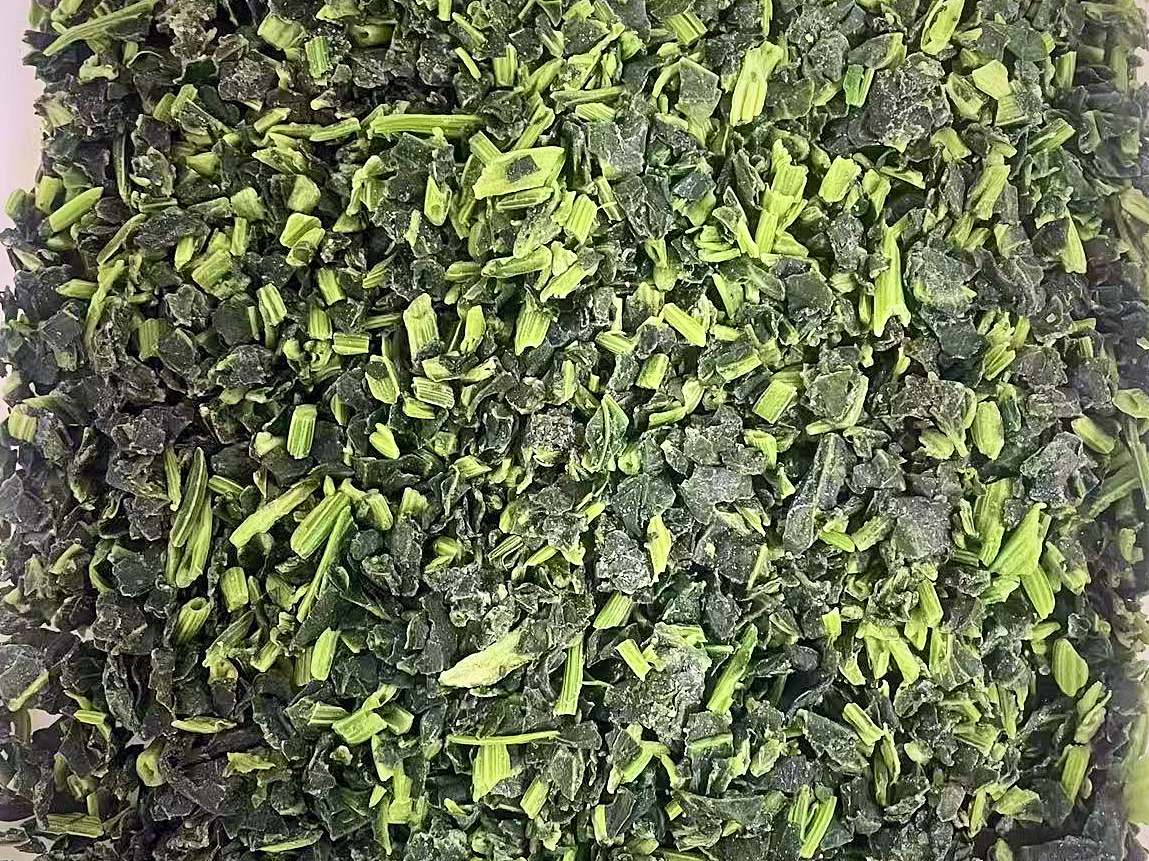
Individually quick frozen (IQF) chopped spinach is cut into small pieces, blanched and frozen so the pieces stay loose rather than setting into a solid block. That free-flowing texture is the main reason buyers choose it: a production line can weigh out exactly the amount a recipe needs and return the rest to the freezer. Our IQF chopped spinach is cut to 10 × 10 mm, a size that works well in fillings, sauces, egg dishes and ready meals where the spinach should still be visible.
Frozen spinach purée
Purée is the choice when spinach should disappear into the product as colour, flavour and nutrition rather than as pieces: green pasta and noodles, baby food, smoothies, dips, sauces and bakery. The key question here is fibre. A purée with fibre has more body; one without fibre is smoother and easier to pump and blend. Our frozen spinach purée is made in both versions, milled with a high-shear purée mill and frozen, with no sugar added.
Frozen seasoned spinach
Seasoned spinach is a finished or nearly finished product rather than an ingredient. The spinach is cut into longer pieces, mixed with seasoning, vacuum packed, pasteurised and then frozen, so the end customer only has to thaw or heat it. This format is popular in Japanese and Korean style side dishes and in retail and food service ranges. Our frozen seasoned spinach is cut into 3–5 cm pieces and seasoned to the customer’s own recipe, in bags from 100 g to 1,000 g.
| Format | Typical uses | Key spec to agree |
|---|---|---|
| IQF chopped | Fillings, sauces, ready meals, egg dishes | Cut size, free-flowing, foreign matter |
| Purée | Pasta, baby food, smoothies, dips, bakery | With or without fibre, consistency |
| Seasoned | Side dishes, retail, food service | Recipe, bag size, shelf life |
What to put in the specification
A good specification protects both sides. It tells the supplier exactly what to make and gives the buyer something objective to inspect against when the goods arrive. For frozen spinach, these are the points most worth agreeing in writing.
Cut size and appearance
State the cut size and the tolerance you can accept, and say whether the product should be mostly leaf or whether some stem is acceptable. Colour matters too: well-blanched spinach should be an even dark green, without yellowed or brown pieces. If you have a reference sample from a previous supplier, share it, because a photo and a physical sample remove a lot of guesswork.
Free-flowing condition
For IQF product, ask how clumping is controlled and what level of lumps you will accept on arrival. Some clumping during long transport is normal for leafy vegetables, but heavy clumping usually points to temperature fluctuation somewhere in the cold chain, and it makes portioning harder in your plant.
Foreign matter
Leafy crops can carry grass, weeds, stones and other field material. Ask what sorting steps are used, whether the line has metal detection, and how foreign matter complaints are investigated. This is one of the most common sources of disputes with frozen spinach, so it deserves a clear limit in the contract.
Blanching and microbiology
Blanching inactivates the enzymes that otherwise cause off-flavours and colour loss in frozen storage, and it reduces the microbial load. Agree the microbiological criteria that apply in your market, such as total plate count, coliforms, E. coli, Salmonella and Listeria monocytogenes, and ask for a certificate of analysis (COA) with each shipment.
Pesticide residues and nitrate
Residue limits are set by the destination country, not by the exporter, so give your supplier the regulation that applies to you and ask how raw material is monitored against it. Spinach is also a crop where nitrate is regularly checked; the EU, for example, sets maximum levels for nitrate in spinach. If your market has a limit, include it in the specification and agree how often it will be tested.
Seasonality: plan around the harvest
Fresh spinach is a cool-season crop. In Shandong it is harvested in spring and autumn, and IQF chopped spinach is packed from those harvests. Our IQF spinach comes from our own planting base and cooperative bases, with production in April and October. Stock is available after each season, not year-round, so buyers who need a steady supply should confirm their annual volume early and agree delivery dates against the season.
Purée and seasoned spinach are different. Because they can be produced from frozen raw material, they are supplied all year round. For buyers who need spinach every month, combining IQF stock booked around the harvest with purée or seasoned products made year-round can make planning much easier.
Packing, shipping and documents
Packing should match how the product will be used. Retail and small food service users often want 1 kg bags, while factories usually prefer bulk cartons that reduce packaging waste and handling time. For our IQF chopped spinach, typical options are 1 kg × 10 bags per carton, 10 kg bulk cartons, or 500 kg large cartons with a PE liner. Purée is packed in bag-in-box bags inside cartons, from 1 kg to 20 kg. Packaging can be customised.
All three formats should be stored and shipped at −18 °C or below, with a shelf life of 24 months at that temperature. A 20′ reefer carries about 10 tonnes of IQF chopped spinach and a 40′ reefer about 22 tonnes; the minimum order is one 20′ reefer container. Make sure your forwarder sets the reefer temperature correctly and that the container is pre-cooled before loading.
On documents, ask in advance which ones your customs broker needs. We supply a certificate of origin, a COA and a phytosanitary certificate with each shipment.
Questions to ask a frozen spinach supplier
- Which formats do you produce, and can I see a sample of each?
- Where does the raw material come from, and when are the harvest seasons?
- What cut sizes and packing options are available?
- How do you control foreign matter, and is there metal detection?
- Which food safety certifications does the plant hold, and can I see the certificates?
- How quickly can you trace a batch back to its raw material?
- What documents come with each shipment?
A supplier who answers these clearly, and in writing, is usually one you can work with over the long term. As a reference point, our plant in Laiyang is HACCP and FSSC 22000 certified, and we can trace a batch back to its raw material within one working day.
Talk to us about frozen spinach
Laiyang City Jiale Food Co., Ltd. has produced frozen fruits and vegetables in Laiyang, Shandong since 2009 and exports to more than 20 countries in Southeast Asia, Europe and North America. If you are comparing frozen spinach formats, see our IQF frozen vegetables range, or contact our sales team with the format, packing, destination port and volume you need. You can also email sales@jiale-food.com or message us on WhatsApp +86 159 6656 2788.