


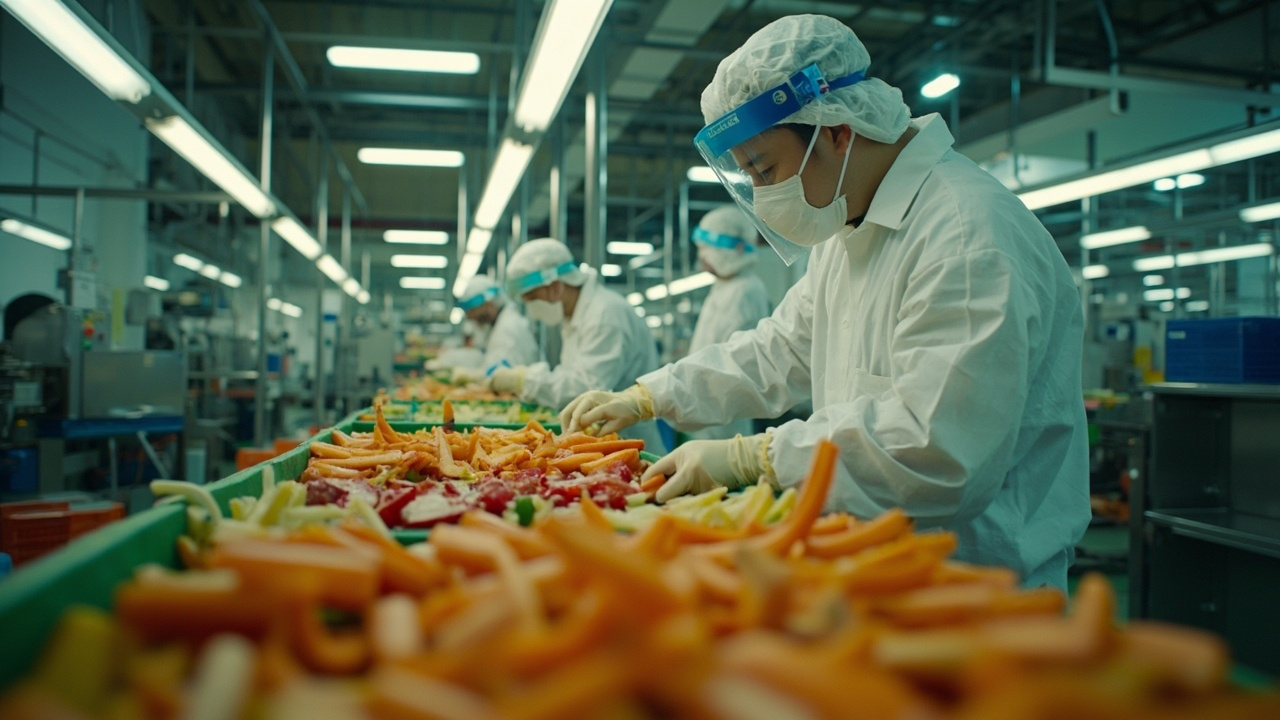
What Is GB 14881-2025?
GB 14881-2025 is the updated National Food Safety Standard for General Hygiene Practices in Food Production, issued on September 2, 2025. It will become mandatory for all food manufacturing enterprises in China on September 2, 2026—replacing the 2013 version.
For fruit and vegetable processors—especially those exporting to international markets—this update brings significant operational changes. This guide breaks down what matters most for your facility.
14 Major Changes at a Glance
The new standard restructures requirements across facility design, process control, personnel hygiene, and documentation. Key additions include:
- Allergen management — dedicated storage, segregated production lines, and mandatory labeling per GB 7718
- Parasite control — new requirements for high-risk raw materials (aquatic products, fresh produce)
- Extended microbiological monitoring — now covers non-food-contact surfaces (drains, cleaning tools, floor mats, footwear)
- Fly control upgrade — electronic fly zappers are prohibited; adhesive traps required
- HACCP integration — HACCP principles now embedded as guidance in the standard itself
Key Requirements by Area
1. Facility Zoning & Layout
Facilities must be divided into three cleaning zones with physical separation:
| Zone | Examples | Requirements |
|---|---|---|
| Clean Area | Aseptic filling, cooling zones | Highest cleanliness, positive air pressure |
| Semi-Clean Area | Raw material pre-treatment | Medium control level |
| General Area | Warehouse, outer packaging | Standard requirements |
2. Allergen Management
If your facility handles nuts, dairy, soy, or other allergens:
- Designated storage areas with clear labeling
- Separate equipment and utensils where possible
- Full cleaning validation between production runs
- Complete allergen use records
3. Microbiological Monitoring Expansion
Monitoring now includes surfaces previously excluded:
- Drains and floor sinks
- Cleaning tools and scrubbers
- Footwear and floor mats
- Wall surfaces near production lines
4. Parasite Control
For fresh produce and aquatic ingredients:
- Risk assessment for each raw material category
- Validation of kill steps (heat treatment, freezing)
- Monitoring records retained for minimum 2 years
5. Pest Control Upgrades
- Facilities must maintain pest control layout diagrams
- Electronic fly zappers are banned — switch to adhesive traps
- All pest control records kept for minimum 2 years (previously 1 year)
Timeline for Compliance
Documentation & Record Keeping
Key record retention changes:
| Record Type | New Retention Period |
|---|---|
| Pest control / parasite monitoring | Minimum 2 years |
| Finished product inspection | Minimum 6 months beyond shelf life, or 2 years minimum |
| Production process records | Minimum 6 months beyond shelf life |
| Traceability & recall | Minimum 6 months beyond shelf life |
What Export-Oriented Processors Should Know
For buyers sourcing from Chinese food manufacturers, GB 14881-2025 alignment demonstrates:
- Risk-based food safety culture — the standard shifts from reactive to preventive
- International alignment — HACCP integration mirrors Codex Alimentarius requirements
- Enhanced traceability — batch-level tracking from raw material to finished product
- Allergen sensitivity — proper allergen controls reduce contamination risk for sensitive markets
Jiale Food’s quality management system already incorporates HACCP principles, FSSC 22000 certification protocols, and comprehensive supplier qualification. We are currently mapping our processes to GB 14881-2025 requirements to ensure full compliance by September 2026.
Ready to Discuss Compliance?
For questions about our food safety systems, upcoming facility upgrades, or how GB 14881-2025 affects your product specifications, contact our export team.
Email: export@jiale-food.com
Data source: GB 14881-2025 Official Standard Text; GB 14881-2025 Implementation Guide (Food Safety Expert Platform, 2026)